Basic Life Support vs First Aid: What Is the Difference?

Basic Life Support vs First Aid: What Is the Difference?
When someone collapses at work or a colleague slices their hand in the kitchen, the response looks completely different depending on which emergency you're facing. First aid covers the everyday injuries and illnesses you're likely to encounter—cuts, burns, sprains, choking—while Basic Life Support (BLS) focuses exclusively on keeping someone alive during cardiac arrest until paramedics arrive.
This article explains what each certification covers, who needs which training, and how to choose the right emergency response qualification for your workplace.
What Is First Aid Training?
First aid is immediate care you give someone who's injured or suddenly ill before professional medical help arrives. It covers everyday emergencies you're likely to see in a workplace or at home—cuts, burns, sprains, fainting, choking—and anyone can learn these skills regardless of their medical background. The training focuses on helping people who are awake and responsive, keeping their condition stable until paramedics or doctors take over.
Think of first aid as your everyday emergency toolkit. Most courses run for one day and teach practical techniques you can use right away when someone gets hurt.
Wound Care and Bleeding Control
First aid training shows you how to stop bleeding using direct pressure, elevation, and the right type of bandage. You'll learn to assess how serious a cut is, apply dressings properly, and recognize when someone needs more than basic wound care.
Burns and Scalds
Burns require specific treatment to limit tissue damage and prevent infection. First aid covers cooling burns under running water for at least ten minutes, covering them with sterile non-stick dressings, and knowing when a burn is serious enough for hospital treatment.
Choking and Airway Obstruction
When food or an object blocks someone's airway, first aid gives you two main techniques: back blows and abdominal thrusts (also called the Heimlich maneuver). These work on conscious casualties and can clear an obstruction before it becomes life-threatening, though they're quite different from the airway techniques used in more advanced emergency training.
Shock and Fainting
Shock is a life-threatening condition where your body's circulation can't deliver enough oxygen to your tissues. First aid training teaches you to spot the signs, position casualties correctly, and monitor their condition while you wait for emergency services to arrive.
What Is Basic Life Support Training?
Basic Life Support (BLS) is advanced emergency training that focuses exclusively on cardiac arrest and life-threatening breathing emergencies. Unlike first aid, which covers a wide variety of injuries and illnesses, BLS zeroes in on one specific scenario: keeping circulation and breathing going in someone who's unresponsive. This training is more intensive than first aid and typically required for healthcare professionals, paramedics, and emergency responders who regularly face cardiac emergencies.
BLS follows protocols from the Resuscitation Council UK and requires you to demonstrate your skills in person—there's no getting around the hands-on assessment. The techniques are physically demanding and technically precise, more so than basic first aid skills.
Cardiopulmonary Resuscitation
CPR is the foundation of BLS training, combining chest compressions and rescue breaths for someone in cardiac arrest. You'll learn the exact compression depth (5-6 centimeters for adults), the right rate (100-120 compressions per minute), and the proper ratio of compressions to breaths. BLS-level CPR is more rigorous than the CPR sometimes taught in first aid courses, with higher standards for both technique and how long you can maintain quality compressions.
Automated External Defibrillator Use
An AED is a portable device that analyzes heart rhythm and delivers electrical shocks to restart a normal heartbeat during cardiac arrest. BLS training covers when to use an AED, how to place the pads correctly, how to make sure no one touches the casualty during shock delivery, and how to coordinate AED use with ongoing CPR.
Advanced Airway Management
BLS includes techniques for keeping airways open in unresponsive patients, including bag-valve-mask (BVM) ventilation. These methods require coordination and practice—improper technique can fail to deliver enough oxygen or even harm the casualty.
Key Differences Between BLS and First Aid
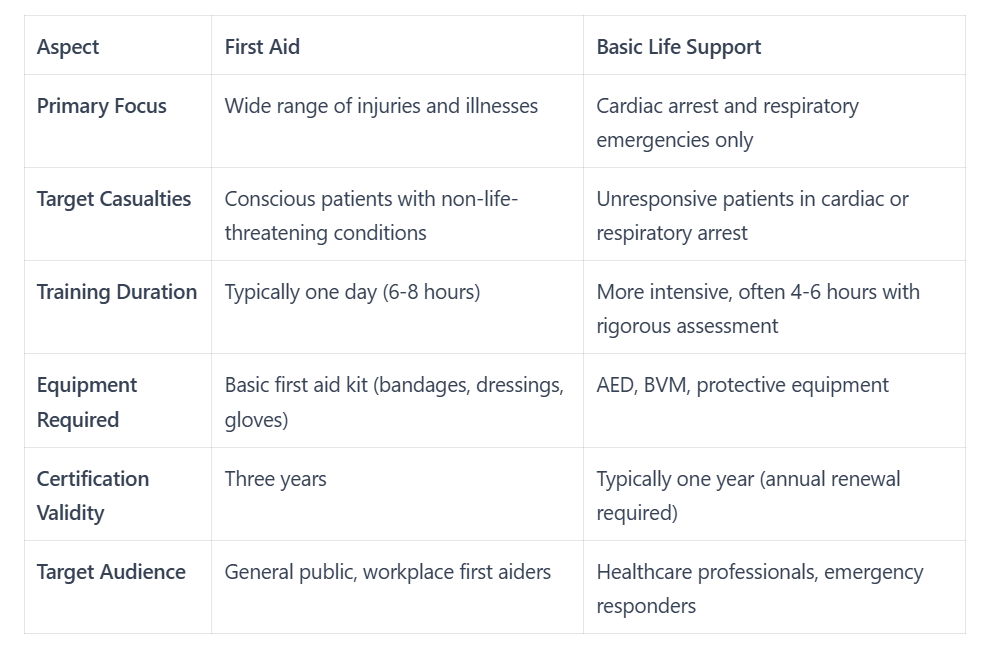
The main difference between BLS and first aid comes down to scope and purpose. First aid addresses a broad range of minor to moderate injuries in people who are awake, while BLS focuses exclusively on life-threatening cardiac and breathing emergencies in people who are unresponsive.
Scope of Practice
First aid covers everything from minor wounds and burns to fractures, allergic reactions, and diabetic emergencies. BLS, on the other hand, addresses only cardiac arrest and situations where breathing has stopped—it's a specialized skill set rather than a comprehensive emergency response toolkit.
Target Situations
You'll use first aid when someone is conscious and experiencing a non-life-threatening emergency that requires immediate attention. BLS becomes necessary when someone is unresponsive and shows no signs of breathing or normal circulation—situations where every minute counts for survival.
Required Equipment
A first aid kit contains bandages, sterile dressings, antiseptic wipes, scissors, gloves, and other supplies for treating injuries. BLS requires an AED, barrier devices for rescue breaths, and often a bag-valve-mask for ventilation—equipment you'll typically only find in healthcare settings or high-risk workplaces.
Training Duration and Depth
First aid courses usually run for six to eight hours and cover multiple topics at a foundational level. BLS training is more concentrated and physically demanding, with significant time spent practicing chest compressions until you can maintain proper depth and rate for extended periods without tiring.
Does BLS Certification Include First Aid?
BLS certification does not include first aid training—they're completely separate qualifications. While BLS focuses exclusively on cardiac emergencies and respiratory arrest, it doesn't cover wound care, burns, fractures, or the dozens of other situations you'll learn about in first aid courses. This means healthcare workers often hold both certifications to be fully prepared for different types of emergencies.
Many UK workplaces require first aid certification regardless of whether employees hold BLS certification, as the two qualifications serve different purposes. If your role involves potential cardiac emergencies, you might pursue BLS; if you're a designated workplace first aider, you'll get first aid certification even if you already have BLS training.
Who Needs First Aid Certification in the UK?
The Health and Safety Executive requires UK employers to provide adequate first aid equipment and trained personnel based on workplace risk assessments. The specific number of trained first aiders depends on factors like workforce size, workplace hazards, and proximity to emergency services, but most workplaces designate at least one first aider.
Workplace First Aiders
Offices, warehouses, retail environments, and most other workplaces have employees trained to provide first aid. Employers conduct risk assessments to determine how many first aiders they require—higher-risk environments like construction sites or manufacturing facilities typically have more trained staff than low-risk office settings.
Teachers and Childcare Providers
Schools, nurseries, and childcare settings have specific first aid requirements under Ofsted regulations. At least one person with a current pediatric first aid certificate stays on the premises whenever children are present, as injuries and medical emergencies in young children require specialized knowledge.
Sports Coaches and Fitness Instructors
Anyone supervising physical activities—from PE teachers to personal trainers—often holds first aid certification to manage sports injuries, cardiac events during exercise, and other emergencies that can occur during physical exertion. While not always legally required, this training is considered best practice and often required by insurance providers.
Who Needs BLS Certification?
BLS certification is primarily for professionals who may encounter cardiac emergencies as part of their role. Healthcare settings and high-risk environments are the main contexts where BLS training becomes necessary rather than simply beneficial.
Healthcare Professionals
Doctors, nurses, paramedics, and hospital staff hold BLS certification as part of their professional registration and continuing education. These professionals are expected to respond to cardiac arrests and respiratory emergencies, making current BLS certification non-negotiable in healthcare settings.
Emergency Medical Services Personnel
Ambulance crews, emergency medical technicians, and other pre-hospital care providers rely on BLS skills to stabilize patients before reaching hospital. Their BLS training is often more advanced than standard courses, incorporating additional protocols for emergency response scenarios.
High-Risk Industry Workers
Facilities management, construction sites, and industrial settings where cardiac events may occur due to electrical hazards, confined spaces, or other risks sometimes require designated employees to hold BLS certification. This is determined by workplace risk assessment and the specific hazards present.
Which Emergency Response Certification Should You Choose?
Your choice between first aid and BLS certification depends on your job role, workplace requirements, and the types of emergencies you're likely to encounter. Here's how different scenarios typically play out:
- For general workplace compliance: First aid certification meets most UK employer requirements and covers the broad range of incidents you're likely to face in typical work environments.
- For healthcare roles: BLS certification is mandatory for clinical staff, though you'll often hold first aid certification as well for non-cardiac emergencies.
- For high-risk environments: Both certifications make sense if your workplace risk assessment identifies both general injury risks and potential cardiac emergency scenarios.
- For childcare and education: First aid with pediatric focus is typically sufficient and specifically addresses the emergencies most common with children.
If you're uncertain which certification your workplace requires, Kasorb's experienced trainers can review your risk assessment and recommend the appropriate training mix for your team. Our on-site delivery means we can tailor course content to the specific hazards and scenarios your staff might actually encounter.
How Often Do You Need to Renew Your Certification?
Both first aid and BLS certifications require renewal to remain valid, though on different schedules. First aid certificates are valid for three years, after which you'll complete a requalification course to renew your certification. BLS typically requires annual renewal, as cardiac resuscitation protocols and techniques are updated more frequently based on ongoing research.
Keeping certifications current isn't just about compliance—emergency response techniques evolve as medical research advances, and skills deteriorate without regular practice. Annual or triennial refresher training helps you stay confident and competent when emergencies actually occur.
Ensure Your Team Has the Right Life-Saving Skills
Choosing between BLS and first aid certification comes down to your workplace risks and regulatory requirements. First aid addresses the wide range of injuries and illnesses you're likely to encounter in most settings, while BLS provides specialized skills for cardiac emergencies that healthcare professionals and high-risk industry workers face.
Kasorb delivers on-site first aid and BLS training across the UK, with courses led by paramedics, ER nurses, and NHS professionals who bring real-world emergency experience into every session. Our flat group rate for up to twelve people makes compliance training straightforward and cost-effective, and we provide all necessary certification and documentation.
Book your team's compliance training today and make sure your workplace is prepared for any emergency.
Frequently Asked Questions About BLS and First Aid
Can I take basic life support training without prior first aid certification?
Yes, BLS training doesn't require first aid as a prerequisite—the two certifications are independent of each other. However, many healthcare employers prefer staff to hold both certifications, as they address different types of emergencies you might encounter in clinical settings.
Is online BLS certification accepted by UK employers and healthcare providers?
Most UK healthcare employers require in-person BLS certification with hands-on assessment, as online-only courses don't meet Resuscitation Council UK standards for practical competency. While some online courses offer theory components, you'll typically demonstrate CPR and AED skills in person to receive recognized certification.
What is the cost difference between BLS and first aid training courses?
BLS courses are typically more expensive than first aid training due to specialized equipment requirements and more intensive hands-on practice. First aid course costs vary based on course length and group size, but group bookings often offer better value than individual certification.
Can non-medical professionals obtain BLS certification in the UK?
Yes, BLS certification is available to anyone who wants to learn the skills, though it's most commonly pursued by healthcare workers and those in high-risk industries where cardiac emergencies are more likely. There are no prerequisites or medical background requirements to enroll in BLS training.


Book a free 15-min consult call with us. We’ll help you get your mandatory training done right.