Which CPR course is for healthcare?

Which CPR Training Is for Healthcare Workers: Course Guide
Healthcare workers face a different reality than the general public when someone goes into cardiac arrest—you're expected to respond, you'll have equipment available, and you'll typically work alongside other trained professionals. That's why standard CPR courses designed for lay rescuers don't meet the requirements for doctors, nurses, paramedics, and other healthcare staff.
This guide explains which CPR certifications healthcare workers actually need, from Basic Life Support (BLS) as the foundation to advanced courses like ACLS and PALS for specialized roles. You'll learn what each certification covers, who requires which qualification, and how healthcare CPR training differs from public courses.
What CPR Training Do Healthcare Professionals Need
Basic Life Support (BLS) is the standard CPR certification for healthcare workers in the UK. The course goes beyond standard public CPR by teaching two-rescuer techniques, bag-valve-mask ventilation, and team coordination—skills that reflect how resuscitation actually happens in hospitals, clinics, and care facilities.
The difference matters because healthcare workers respond to emergencies as part of their job, not as bystanders. You'll have access to equipment like bag-valve-masks and AEDs, and you'll typically work alongside other trained professionals during a cardiac arrest. BLS training prepares you for that reality.
Depending on where you work, you might also require additional certifications. Emergency department staff often hold Advanced Cardiovascular Life Support (ACLS), while those treating children typically add Pediatric Advanced Life Support (PALS) to their credentials.
Basic Life Support (BLS) for Healthcare Providers
BLS serves as the foundation for anyone providing patient care in the UK. The course assumes you'll respond to cardiac and respiratory emergencies as part of your professional responsibilities, which changes both what you learn and how you learn it.
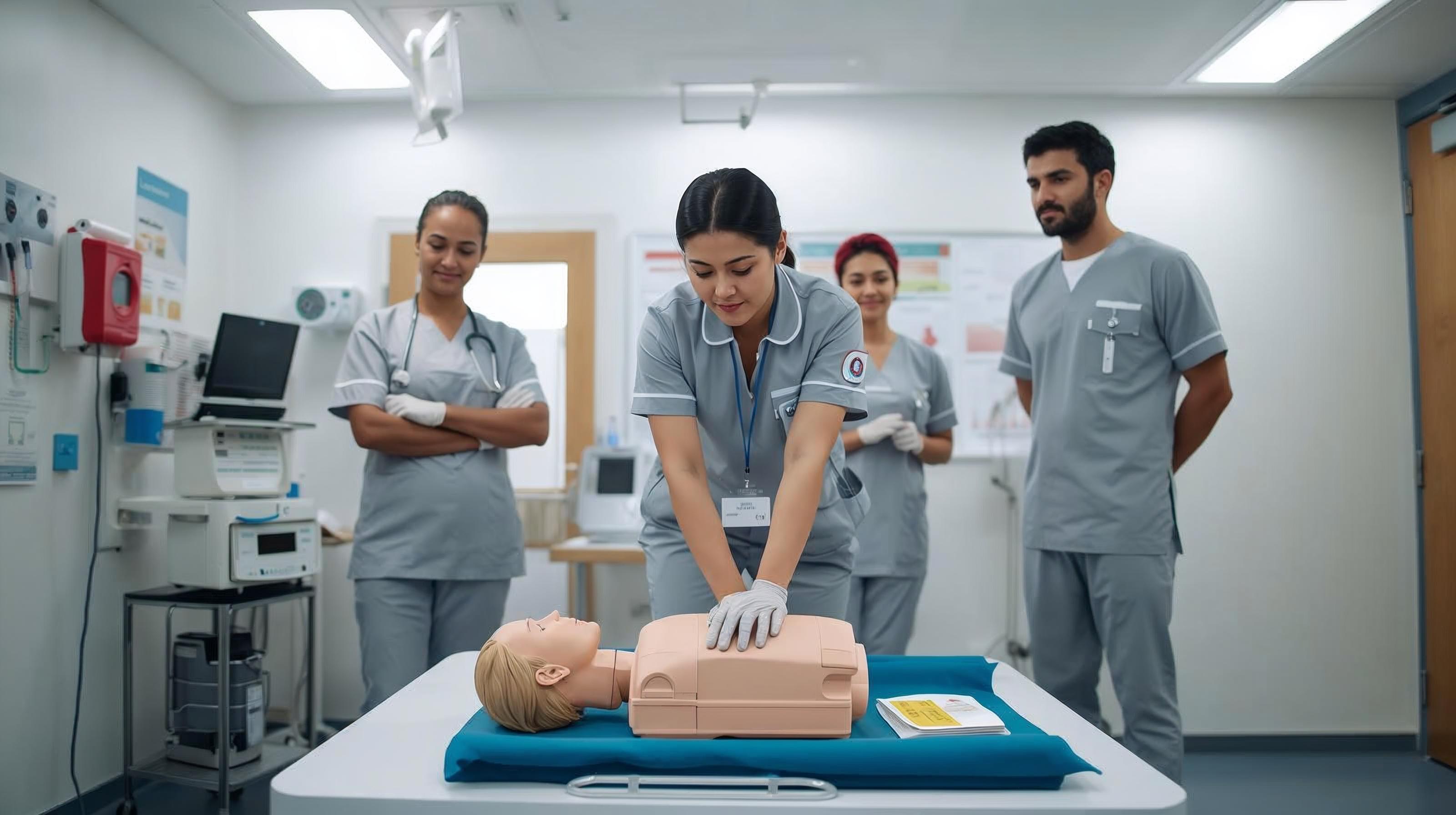
Unlike public CPR courses that focus on single-rescuer scenarios, BLS emphasizes working as part of a team. You'll practice communicating during resuscitation efforts, coordinating role switches, and maintaining high-quality compressions even when multiple people are involved.
What BLS Certification Covers
BLS courses teach the practical skills you'll use during actual emergencies in healthcare settings:
- High-quality chest compressions: Proper depth (5-6 cm for adults), rate (100-120 per minute), and hand placement, with minimal interruptions
- Rescue breathing: Mouth-to-mouth, bag-valve-mask ventilation, and pocket mask techniques for effective oxygenation
- AED operation: When to shock, when not to shock, and how to integrate defibrillation into ongoing CPR
- Team coordination: How to assign roles, switch positions during extended efforts, and communicate clearly under pressure
- Choking relief: Abdominal thrusts and back blows for conscious and unconscious patients of all ages
The training focuses heavily on compression quality because research shows that depth, rate, and chest recoil directly affect survival rates. You'll practice on manikins until the technique becomes automatic, so you can perform it confidently when someone's life depends on it.
Who Requires BLS Training
Most healthcare roles require BLS certification as a condition of employment or professional registration. The qualification demonstrates you can respond appropriately to cardiac emergencies while providing patient care.
Healthcare professionals who typically hold BLS certification include:
- Doctors, nurses, and midwives
- Paramedics and emergency medical technicians
- Dental professionals and hygienists
- Physiotherapists and occupational therapists
- Care home staff and healthcare assistants
- Radiographers and diagnostic imaging professionals
Even if you work outside emergency settings, your employer will likely require BLS because cardiac arrests can happen anywhere patients receive care—from outpatient clinics to dental surgeries.
BLS Validity and Renewal
BLS certificates remain valid for two years from the issue date. After that, you'll complete a recertification course to maintain your qualification and continue working in healthcare roles.
Most professional bodies and employers won't accept expired certifications, even by a few days. Booking your renewal three to four weeks before expiry gives you buffer time if scheduling conflicts arise.
Advanced Cardiovascular Life Support (ACLS)
ACLS builds on BLS by adding advanced interventions for cardiac emergencies. The course targets healthcare professionals who lead or participate in resuscitation teams, particularly in settings where patients experience acute cardiac events.
While BLS focuses on the physical skills of CPR and basic airway management, ACLS introduces ECG interpretation, medication administration, and clinical decision-making during cardiac arrest. You'll learn systematic approaches to different arrest rhythms, from ventricular fibrillation to pulseless electrical activity.
When Healthcare Workers Need ACLS
ACLS isn't universal—it's specifically designed for those working in acute care settings where they'll manage critically ill patients.
Roles that typically require ACLS include:
- Emergency department doctors and nurses
- Intensive care unit staff
- Cardiac care unit personnel
- Anaesthetists and surgical teams
- Advanced paramedics
If you work in a general ward or community setting, BLS alone is usually sufficient. However, some employers prefer ACLS for senior nursing roles even outside critical care.
ACLS Course Components
ACLS courses cover interventions that extend well beyond basic CPR:
- ECG interpretation: Reading cardiac rhythms to identify the type of arrest and determine treatment
- Medication protocols: Understanding drugs used during cardiac emergencies, including adrenaline, amiodarone, and atropine
- Advanced airway management: Intubation and supraglottic airway insertion for patients who can't maintain their own airway
- Post-arrest care: Stabilizing patients after successful resuscitation, including targeted temperature management
The training uses simulation-based scenarios that mirror real cardiac emergencies. This approach helps you develop the clinical judgment to make rapid decisions when every second counts.
Pediatric Life Support Training
Children aren't just smaller versions of adults—their physiology and common emergencies differ significantly. Healthcare workers treating pediatric patients require specialized training that addresses those differences.
Pediatric courses emphasize preventing cardiac arrest in children, since most pediatric arrests result from respiratory failure rather than primary cardiac problems. Early recognition and intervention can often stop deterioration before it reaches cardiac arrest.
PALS for Healthcare Professionals
Pediatric Advanced Life Support (PALS) is the standard course for healthcare providers managing critically ill or injured children. The training covers systematic assessment, recognition of respiratory distress and shock, and management of pediatric cardiac arrest.
PALS certification is typically required for emergency department staff, pediatric intensive care nurses, anesthetists working with children, and paramedics. The course combines knowledge-based learning with hands-on practice through realistic pediatric scenarios.
PEARS for First Responders
Pediatric Emergency Assessment, Recognition, and Stabilization (PEARS) serves as an introductory course for providers who don't regularly treat critically ill children but might encounter pediatric emergencies. The focus is on early identification and initial stabilization rather than advanced management.
PEARS works well for general ward nurses, community healthcare workers, and others who would quickly transfer a sick child to pediatric specialists. It bridges the gap between BLS and full PALS certification.
Healthcare Provider CPR vs Standard CPR
The distinction between healthcare provider CPR and public CPR courses matters when it comes to professional requirements and practical capability. Healthcare certifications assume you'll respond to emergencies as part of your job, with access to equipment and support from other trained professionals.
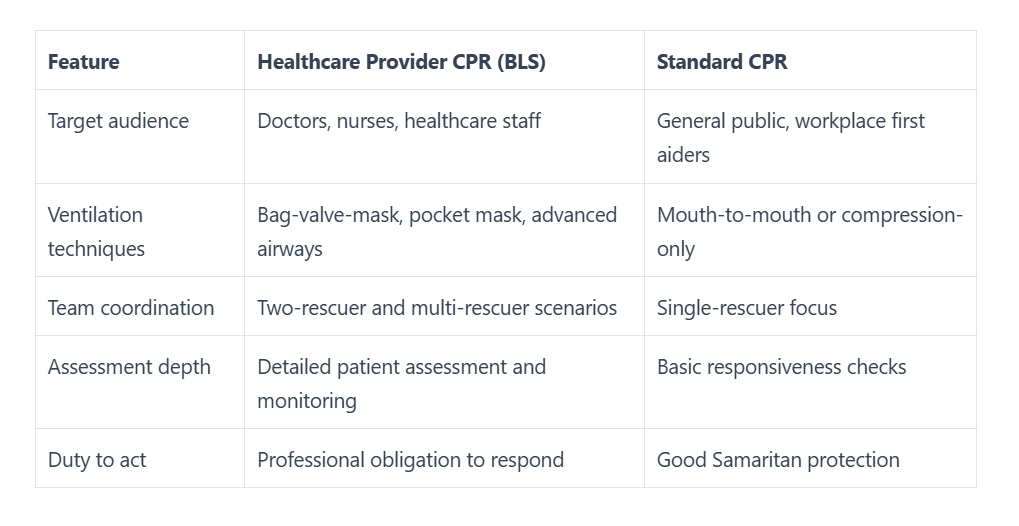
Standard CPR courses teach compression-only CPR as an option for lay rescuers uncomfortable with rescue breaths, but healthcare providers are expected to deliver both compressions and ventilations. The training also assumes you'll have barrier devices, bag-valve-masks, and other equipment not typically available to the public.
Perhaps most importantly, healthcare courses include scenarios where you'll coordinate with other rescuers, communicate during the resuscitation, and switch positions to maintain quality during extended efforts. These team dynamics are critical in healthcare settings but aren't covered in public courses.
CPR Certification Requirements for Healthcare Roles
Different healthcare roles carry different certification requirements, though BLS serves as the baseline for nearly everyone providing patient care. Understanding what's required for your specific position helps you maintain compliance with professional registration and employer policies.
Hospital Staff Requirements
Most hospital positions require BLS certification regardless of department or specialty. This universal requirement reflects that cardiac emergencies can occur anywhere in a hospital—from outpatient clinics to operating theaters.
Emergency departments, intensive care units, and cardiac care units typically require both BLS and ACLS for medical and nursing staff. Pediatric units add PALS to these requirements.
Care Home and Community Healthcare
Care home staff, community nurses, and domiciliary care workers typically hold BLS certification to respond to cardiac emergencies while waiting for ambulance services. The training prepares them to provide effective CPR and use an AED during those critical first minutes.
Community settings present unique challenges because you often work alone without immediate backup. BLS training prepares you to manage emergencies independently until paramedics arrive.
Allied Health Professionals
Physiotherapists, occupational therapists, radiographers, and similar roles usually require BLS even though they don't work in emergency settings. The requirement reflects that these professionals have a duty of care and might witness a cardiac arrest during routine patient contact.
Speech therapists, dietitians, and other allied health professionals working clinically typically face the same BLS requirements. Professional registration bodies often specify that maintaining current CPR certification is a condition of continued registration.
Group CPR Training for Healthcare Teams
Training entire teams together offers advantages over sending individuals to separate courses. When you practice resuscitation scenarios with the colleagues you'll actually work alongside during emergencies, you develop the communication patterns and role clarity that improve real-world performance.
Group training also allows practice with your workplace's actual equipment in your real clinical environment. This familiarity matters during emergencies when you're locating equipment quickly and working efficiently in your specific space.
On-site training benefits include:
- Workplace delivery: Training at your facility eliminates travel time and allows practice with your own equipment
- Team coordination: Practice with colleagues you'll work with during actual emergencies
- Cost efficiency: Group bookings typically offer better value per person than individual courses
- Flexible scheduling: Sessions arranged around shift patterns minimize disruption to patient care
Kasorb delivers on-site CPR training with flat rates for up to twelve staff members, with experienced paramedics and ER nurses as instructors. Book your team's training to develop the coordination that matters during real emergencies.
Healthcare CPR Recertification Process
Healthcare CPR certifications expire after two years, and you'll renew before expiry to maintain professional registration and employment eligibility. Most healthcare employers won't accept expired certifications, even by a few days, because they're required to demonstrate that all staff maintain current competencies.
Recertification courses are shorter than initial training, often taking just a few hours rather than a full day. The focus shifts to refreshing your skills, correcting technique drift, and updating you on guideline changes.
You'll still demonstrate competency in all core skills—chest compressions, rescue breaths, AED use, and team coordination—but the course assumes you're already familiar with the material. This makes recertification more efficient while ensuring you maintain the quality technique that saves lives.
Frequently Asked Questions About Healthcare CPR Courses
What is the difference between BLS and CPR for healthcare providers?
BLS (Basic Life Support) is the specific CPR certification designed for healthcare providers, while "CPR" often refers to courses for the general public. BLS includes bag-valve-mask ventilation and two-rescuer coordination that standard courses don't cover, reflecting the professional responsibilities and resources available in healthcare settings.
Can healthcare workers complete CPR training entirely online?
Healthcare CPR certification requires hands-on skills assessment, so fully online courses aren't accepted for professional registration or employment. Some providers offer blended learning with online theory and in-person practical assessment, which can reduce face-to-face training time.
How long does healthcare provider CPR training take to complete?
BLS courses typically take half a day, while ACLS requires one to two full days depending on the provider. Recertification courses are shorter, often completed in three to four hours.
What happens if my healthcare CPR certification expires?
If your certification expires, you'll complete a full initial course rather than a shorter recertification course. Many healthcare employers require current certification as a condition of employment, so renewing before expiry avoids gaps in your ability to work clinically.
Is ACLS required for all nurses in the UK?
ACLS isn't required for all nurses—BLS is the standard requirement across most healthcare roles. ACLS is typically required for nurses in emergency departments, intensive care units, and cardiac care where they manage critically ill patients experiencing cardiovascular emergencies.


Book a free 15-min consult call with us. We’ll help you get your mandatory training done right.