eLearning vs in-person and live virtual training: which is better?


eLearning vs In-Person and Live Virtual Training: Which Is Better?
Choosing the right training format for your team affects more than just your budget—it determines whether your staff can actually respond effectively when emergencies happen. Online courses promise convenience and cost savings, while in-person sessions offer hands-on practice, and live virtual training attempts to split the difference.
The answer depends on what you're teaching and what UK regulations require for your industry. This article examines how each training method works, when each format delivers the best results, and how to match your compliance obligations with the right delivery approach.
What Are eLearning, In-Person Learning, and Live Virtual Training?
The world of workplace training now offers three main delivery methods, each with distinct characteristics that suit different learning goals. Understanding what separates these approaches helps you choose the right format for your team's compliance requirements.
In-Person Training
In-person training brings instructors and learners together in the same physical space—usually a classroom, training center, or your actual workplace. This traditional format allows participants to practice with real equipment, ask questions face-to-face, and receive immediate feedback during hands-on exercises. For first aid or fire safety training, your staff can physically handle defibrillators, fire extinguishers, and other emergency equipment while an instructor watches and corrects their technique.
eLearning and Self-Paced Online Courses
eLearning refers to digital training content that participants access remotely on their own schedule, typically through a learning management system or video platform. The key feature here is that courses are asynchronous—meaning learners can start, pause, and complete modules whenever they want without coordinating with an instructor or other participants. Content usually consists of pre-recorded videos, interactive quizzes, and downloadable resources.
Live Virtual Instructor-Led Training
Live virtual training sits somewhere between the other two methods. Instructors and participants connect through video conferencing platforms like Zoom or Teams at a scheduled time, similar to in-person sessions. The difference is that everyone joins remotely from their own devices rather than gathering in one location. These sessions happen in real-time with opportunities for questions, discussions, and breakout room activities, unlike pre-recorded eLearning.
Are Online Classes as Effective as In-Person Classes?
Here's the straightforward answer: effectiveness depends more on what you're teaching than how you're teaching it. For knowledge-based content—like policy updates, regulatory awareness, or theoretical concepts—online learning can achieve similar results to traditional classroom instruction.
But when training involves practical skills that require physical demonstration, in-person instruction typically proves more effective. Think about compliance training for emergency response, manual handling, or equipment operation. You can watch a video showing proper CPR compression depth, but that doesn't build the muscle memory or confidence you'll need when someone collapses in your workplace. Only hands-on practice with a manikin and immediate instructor feedback develops genuine competence.
The quality of instruction matters more than the delivery format alone. An engaging online course with interactive elements can outperform a dull in-person lecture, while an experienced instructor leading practical exercises will always beat passive video watching for hands-on skills.
Benefits of In-Person Learning for Practical Skills
For workplace compliance training involving emergency response or safety procedures, in-person delivery offers advantages that digital alternatives simply can't replicate. These benefits become particularly important when your team's ability to respond correctly in high-pressure situations depends on their training.
Hands-On Practice With Real Equipment
Physical interaction with actual equipment builds muscle memory and familiarity that screen-based learning cannot provide. When your staff practice using fire extinguishers, they learn the weight of the canister, the resistance of the trigger, and the spray pattern of the suppressant—sensory experiences that build confidence during an actual fire.
Manual handling training works the same way. Practicing with real loads teaches proper body positioning and weight distribution that prevents workplace injuries. You can't learn how something feels by watching it on a screen.
Immediate Feedback From Expert Instructors
Trainers with frontline experience—paramedics, emergency nurses, or other professionals who've responded to actual incidents—can observe each participant's technique and correct errors in real-time. If someone's hand position during CPR compressions isn't quite right, an instructor can adjust it immediately rather than allowing incorrect technique to become habit. This personalized guidance addresses individual learning gaps that standardized online content can't anticipate or fix.
Higher Engagement and Knowledge Retention
Physical presence in a training environment naturally reduces distractions compared to learning from a home office or workplace desk. Interactive scenarios and group practical exercises maintain attention more effectively than watching a screen. Active participation in realistic scenarios produces stronger learning outcomes than passive content consumption—you remember what you actually do, not just what you watch.
Team Building and Peer Learning
When colleagues train together, they develop shared understanding and build workplace relationships that enhance team cohesion. Participants learn from each other's questions and experiences during group exercises, creating a richer learning environment than individual online study. Your team also feels more comfortable asking questions out loud than typing them in a chat box.
When Is Online Learning Better Than In-Person Training?
While hands-on compliance training works best in person, certain situations make online learning a practical choice. Understanding when digital delivery makes sense helps you allocate your training budget effectively across different learning objectives.
- Remote workers: Employees working from home or across multiple locations can access online training without travel requirements, particularly valuable for distributed teams or shift workers who can't attend scheduled in-person sessions.
- Large workforces: One digital course can reach many participants simultaneously, eliminating venue hire and trainer travel expenses—though these savings diminish when you factor in platform subscriptions and the inability to verify practical competence.
- Consistent messaging: Every learner receives identical information when completing the same online module, reducing variability that can occur with different instructors or training sessions.
- Self-paced progression: Learners can move through material at their own speed, pausing to review complex concepts or moving quickly through familiar content—though this flexibility works best for theoretical topics rather than practical skill development.
How Effective Is Live Virtual Training?
Live virtual training occupies a middle ground between self-paced eLearning and in-person instruction. For theory-based content and group discussions, this format can work reasonably well—participants can ask questions, engage in breakout room activities, and receive immediate clarification from instructors.
However, live virtual sessions face significant limitations for practical compliance training. Participants can't physically demonstrate techniques or receive tactile feedback on their performance, which proves essential for emergency response skills. An instructor can't observe whether someone's hand placement is correct during a virtual first aid demonstration, nor can they verify proper body mechanics during manual handling practice.
Technical difficulties also disrupt virtual sessions more frequently than in-person training. Poor internet connections, audio problems, or platform glitches can prevent full participation—particularly frustrating when they occur during critical skill demonstrations or practical assessments.
Cost Comparison of Training Methods
Understanding the full cost picture helps you evaluate which training method delivers the best value for your compliance obligations. Initial price points vary, but hidden costs and value factors significantly impact the true investment.
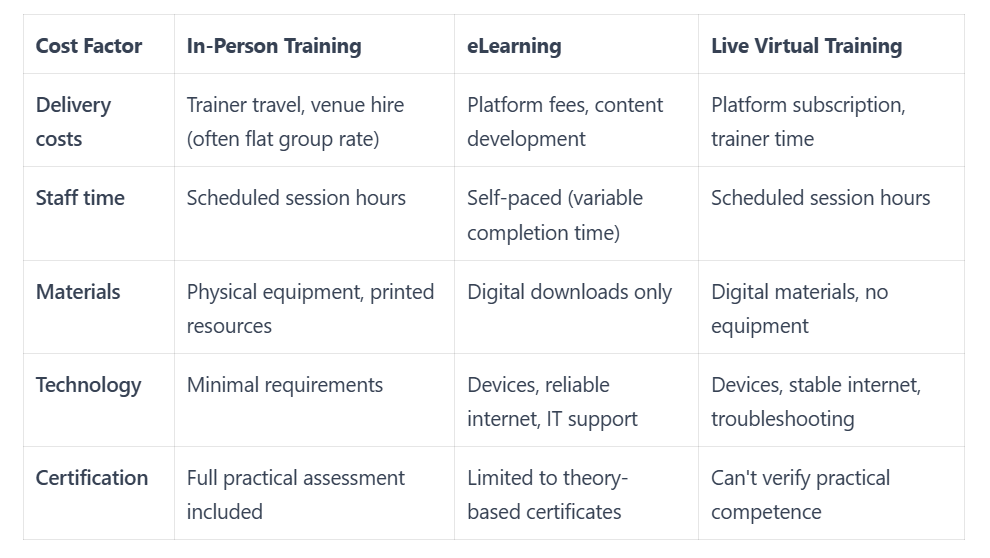
In-person training often offers flat group rates that make per-person costs competitive when training teams together. This pricing structure becomes increasingly cost-effective as group size grows, while also ensuring every team member receives hands-on practice and verified competence.
Online options may appear cheaper initially, but organizations often discover additional expenses for technology support, content updates, and follow-up in-person assessments when regulations require practical demonstration.
Choosing Between In-Person vs Online Learning
The right training method aligns with your specific compliance requirements, workplace risks, and learning objectives. Several factors can guide your decision.
When In-Person Learning Is Essential
Regulatory requirements often mandate hands-on assessment for compliance certification, particularly for first aid, fire safety, and manual handling training. UK Health and Safety Executive guidance emphasizes practical demonstration of competence for many workplace safety obligations, which online-only training can't satisfy.
Skills requiring physical demonstration—CPR technique, fire extinguisher operation, or proper lifting mechanics—develop correctly only through in-person instruction. High-risk environments where staff may face emergencies demand verified practical competence rather than theoretical knowledge alone. Your team also gains confidence through realistic scenario practice that prepares them for actual workplace incidents.
When eLearning Makes Sense
Theoretical knowledge updates or policy refreshers work well in digital format, particularly when content rarely changes and doesn't require physical practice. Organizations with large, geographically dispersed workforces sometimes use eLearning for initial awareness training before scheduling practical sessions. Budget constraints may also necessitate online delivery for non-critical training that doesn't involve emergency response or safety-critical skills.
When Live Virtual Training Works Best
Live virtual sessions can supplement in-person training for follow-up discussions or refresher content between certification renewals. Teams spread across multiple locations might use virtual sessions for policy updates or awareness training that doesn't require hands-on practice. However, virtual sessions work best as additions to rather than replacements for practical in-person instruction when physical skills matter.
Finding the Right Training Solution for Your Team
Your training method matches your compliance obligations and the actual risks your staff face in their workplace. For mandatory training requiring practical skills and regulatory certification—first aid, fire safety, or manual handling—in-person delivery with experienced instructors ensures your team gains usable emergency response abilities rather than just theoretical knowledge.
Choosing a provider whose trainers bring frontline expertise guarantees your training reflects real-world scenarios and current best practices. Paramedics, emergency nurses, and other professionals who've responded to actual incidents can share insights and context that pre-recorded videos can't capture.
Book your team's compliance training with experienced professionals and prepare them for real workplace situations.
FAQs About Training Delivery Methods
Can online compliance training meet UK regulatory requirements?
Some compliance training can be completed online for theory components, but most UK regulations require in-person practical assessment and demonstration of skills for full certification.
How do certification validity periods differ between online and in-person training?
Certification validity periods are determined by regulatory bodies and training type rather than delivery method, though in-person training with practical assessment typically meets more stringent compliance standards.
What technology do participants need for virtual training sessions?
Participants require a reliable internet connection, a device with camera and microphone, and video conferencing software, though technical issues can disrupt learning and prevent full participation.
Can practical skills like first aid be learned effectively through online courses?
Practical emergency response skills require hands-on practice with real equipment and instructor feedback to develop muscle memory and confidence, which can't be replicated through screen-based learning alone.
How many staff members can attend a single in-person training session?
Group sizes vary by training type and provider, with many offering flat rates for teams that make per-person costs competitive with online alternatives while ensuring personalized attention.


Book a free 15-min consult call with us. We’ll help you get your mandatory training done right.