Workplace First Aid Training - First Aid At Work Course UK

Workplace First Aid Training - First Aid at Work Course UK
Every UK workplace faces potential medical emergencies, from minor injuries to life-threatening cardiac arrests, and employers are legally required to have trained first aiders ready to respond. Yet many organisations struggle to determine what level of training their team actually needs and how to arrange it without disrupting operations or breaking the budget.
This guide covers what First Aid at Work (FAAW) training involves, who needs it, how the three-day course works, and how to book practical, compliance-focused training that prepares your team for real workplace emergencies.
What First Aid At Work Training Means Under UK Law
First Aid at Work (FAAW or FAW) is an 18-hour qualification delivered over three days that trains workplace first aiders to handle injuries and medical emergencies. The course covers CPR, using an automated external defibrillator (AED), managing bleeding and shock, treating burns and fractures, and responding to conditions like heart attacks, strokes, and anaphylaxis. It meets the requirements set out in the Health and Safety (First Aid) Regulations 1981, which legally require UK employers to provide adequate first aid based on their workplace risks.
The law doesn't prescribe exactly how many first aiders you need or which course they take. Instead, employers conduct a first aid needs assessment that looks at the specific hazards in their workplace, how many people work there, what shifts they work, and how far away emergency services are.
Legal Duties Under The Health And Safety First Aid Regulations
The regulations place three main responsibilities on employers: providing trained first aiders, keeping appropriate first aid equipment on hand, and establishing clear procedures for handling injuries and illness at work. Your first aid needs assessment determines what "adequate and appropriate" actually means for your specific situation rather than following a generic checklist.
The Health and Safety Executive (HSE) publishes guidance to help employers work through this assessment process. However, the final decision about what your workplace needs rests with you as the employer, since you know your environment and risks better than anyone else.
Differences Between FAW EFAW And FAAW
FAAW and FAW are two names for the same qualification—the full First Aid at Work course. You'll see both abbreviations used interchangeably, but they describe identical training. The confusion typically comes up when comparing this with Emergency First Aid at Work (EFAW), which is a different, shorter course.
Here's how they break down:
- FAAW/FAW: Three-day comprehensive course covering a wide range of injuries and medical emergencies, appropriate for higher-risk workplaces
- EFAW: One-day basic course focused on immediate life-threatening situations, designed for lower-risk environments
Your needs assessment tells you which qualification fits your workplace, though many organisations train at least some staff to the full FAAW level for more thorough coverage.
Who Needs Level 3 First Aid At Work Certification
Your workplace risk assessment answers this question more accurately than any industry rule of thumb. While some people look at staff numbers or business sectors, the most reliable approach examines what could actually go wrong in your environment and what skills your first aiders would need to handle those situations.
FAAW training becomes relevant when your work activities make incidents more likely or potentially more serious. Think about realistic scenarios in your workplace and what level of competence someone would need to manage them until paramedics arrive.
High-Risk Workplace Criteria
Certain environments typically warrant FAAW-trained first aiders rather than just EFAW coverage. Manufacturing sites often involve machinery and materials that can cause injuries requiring more than basic first aid knowledge. Construction sites present hazards like working at height and heavy equipment. Healthcare facilities face medical emergencies beyond typical workplace injuries, and chemical handling operations carry their own specific risks.
Even lower-risk offices sometimes choose FAAW if they have large numbers of staff, occupy multiple floors, or simply want first aiders with broader capabilities and confidence.
Staff Headcount And First Aider Ratios
The number of FAAW-trained first aiders depends on how many people work for you, what shifts they work, and what level of risk they face. HSE guidance offers considerations rather than strict ratios because a 50-person office and a 50-person factory have completely different needs.
You'll want coverage across all working hours, accounting for breaks, holidays, and sick days. Many organisations train more first aiders than the minimum to avoid gaps. If you occupy multiple buildings or floors, you might position first aiders in each area for faster response times.
FAAW Course Content And Learning Outcomes
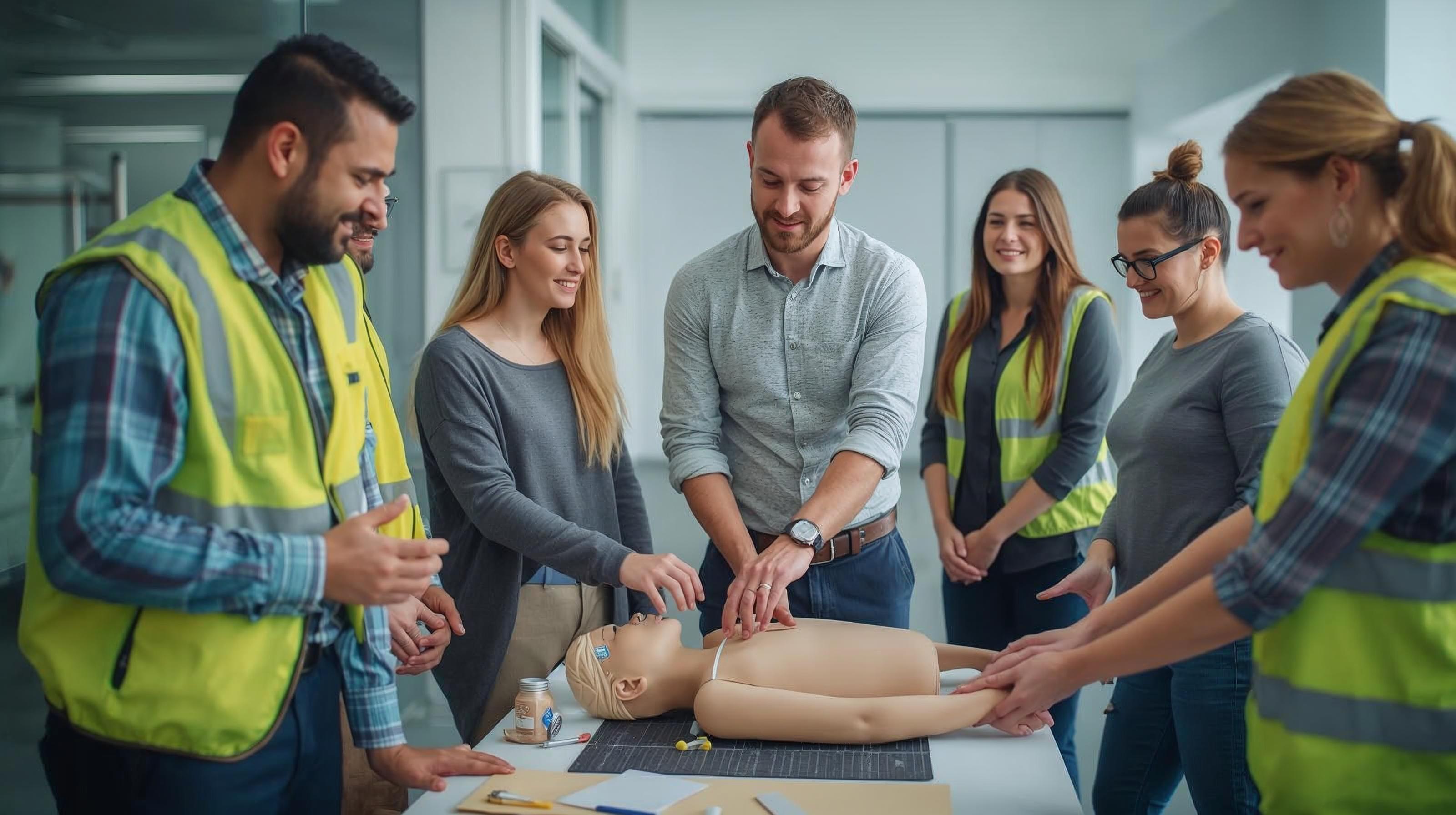
The FAAW course builds practical skills through hands-on scenarios and guided practice rather than lectures. You'll spend most of your time actively practising techniques, working through realistic situations, and getting immediate feedback from instructors. This approach develops both technical ability and the confidence to act when someone needs help.
Primary Survey And CPR
You'll learn to conduct a systematic check using the DRABC approach—Danger, Response, Airway, Breathing, Circulation—to quickly assess someone's condition and decide what to do first. This includes managing the airway, checking breathing, placing an unconscious but breathing person in the recovery position, and recognising when CPR is needed.
The course dedicates significant time to adult CPR technique, with extensive practice to build muscle memory. You'll learn correct hand position, how deep and fast to compress, and how to add rescue breaths while maintaining compression quality.
AED Use
Automated external defibrillators can dramatically improve survival rates in cardiac arrest, but only if first aiders know when and how to use them confidently. You'll practise deploying an AED, running safety checks, placing pads correctly, and following voice prompts while continuing high-quality CPR.
The training covers how to integrate the AED into your response and minimise interruptions to chest compressions.
Managing Bleeding And Shock
Serious bleeding requires quick, effective action to prevent shock and keep someone alive until help arrives. You'll develop practical skills in bleeding control including applying direct pressure, choosing appropriate dressings, and using bandaging techniques that maintain pressure while freeing your hands for other tasks.
The course also covers recognising shock, understanding why it happens, and taking steps to treat and monitor someone until paramedics arrive.
Secondary Illness And Injury Care
Beyond immediate life threats, FAAW training prepares you to handle a wide range of injuries and medical emergencies through scenario-based learning. You'll practise managing burns and scalds of varying severity, recognising different types of fractures and sprains, and knowing when to immobilise an injury.
The course covers head, neck and spinal injuries with focus on keeping casualties safe. You'll learn to recognise and respond to chest injuries, poisoning, chemical exposure, asthma attacks, anaphylaxis, seizures, and diabetic emergencies. Eye injuries, minor wound care, and other common workplace incidents round out the skillset, preparing you for realistic scenarios you might actually face.
Course Duration Assessment And Certificate Validity
FAAW training takes three full days to cover the content and provide enough practice time for genuine competence. This timeline reflects what's actually needed to build real capability rather than superficial familiarity with first aid procedures.
Three-Day Classroom Schedule
Training alternates between short theory segments and frequent practical sessions, with plenty of time for group work, realistic scenarios, and questions. You'll revisit key skills multiple times across the three days, building on previous practice and refining technique based on instructor feedback.
Full attendance and active participation are required to meet the learning outcomes. The course can't be condensed while maintaining the quality and depth that FAAW certification represents.
Practical And Written Assessments
Rather than a single exam at the end, FAAW assessment happens continuously throughout the three days. Your instructor observes your practical skills during scenarios and hands-on practice, providing feedback and tracking your developing competence across all key areas.
You'll also complete short knowledge checks that confirm your understanding of when and why to use different techniques. This ongoing approach reduces pressure while verifying you genuinely meet the standard across every aspect of the course.
Certificate Length And Level 3 Accreditation
Successful completion earns you a First Aid at Work certificate valid for three years from the issue date. The qualification sits at Level 3 in the Qualifications and Credit Framework, reflecting its comprehensive nature and the competence expected of workplace first aiders.
Your certificate meets HSE requirements for designated workplace first aiders, and employers can use it as evidence of adequate training when demonstrating compliance with first aid regulations.
On-Site Versus Open Course Delivery Options
You can choose between on-site training at your workplace or an open course at an external venue. Each approach offers distinct advantages depending on your circumstances, team size, and operational needs.
Benefits Of On-Site Training
Training in your actual workplace means practising in the spaces where you'll respond to real incidents. Your team learns where equipment is stored, how to navigate your specific layout, and how to coordinate with the colleagues they'll work alongside during actual emergencies.
On-site delivery also eliminates travel time and expenses while keeping your team together for all three days. This builds cohesion and creates consistency, making coordinated responses more effective. For organisations training multiple first aiders, on-site delivery typically offers better value and less disruption than sending individuals to separate courses.
When An Open Course Makes Sense
Open courses work well when you're training just one or two people, mixing requirements across different departments, or facing scheduling and space constraints. They also give your first aiders opportunities to learn alongside people from other organisations, sometimes bringing fresh perspectives and questions that enrich the experience.
If your workplace lacks suitable space for practical training or you need to fill a gap quickly, an open course might be your most efficient option.
Group Pricing And How Kasorb Saves You Money
Training costs can add up quickly when certifying multiple first aiders, especially with per-person pricing and multiple course dates. Kasorb's pricing structure removes this complexity and maximises your training budget.
Flat Rate For Up To 12 Delegates
Kasorb's on-site FAAW training uses a single flat rate covering up to 12 delegates. Whether you're training three people or twelve, you pay the same price. This makes budgeting straightforward and lets you train everyone who needs certification without worrying about incremental costs.
The flat rate includes instructor time, all training materials, assessment, and certification for every delegate.
Hidden Costs Of Per-Delegate Courses
Per-person pricing models often mask the true cost of training your team. Beyond course fees, you're paying for staff time away from work—potentially across multiple dates if everyone can't attend together. Travel time and expenses multiply when individuals attend courses at external venues.
Perhaps more significantly, training people separately means inconsistent learning experiences, making coordinated emergency responses more difficult.
Step-By-Step Guide To Booking Your FAAW Training
Getting your team trained doesn't need to be complicated. Here's how to move from deciding you need FAAW training to having certified first aiders ready to respond.
1. Check Team Requirements
Start by reviewing your first aid needs assessment to confirm how many FAAW-trained first aiders you need and where to position them. Consider your shift patterns—you'll want coverage across all working hours, factoring in holidays and absences.
Look at your current first aider certificates too. If any are approaching their three-year expiry, those individuals will need requalification training rather than the full FAAW course.
2. Pick Dates And Location
Decide whether on-site or open course delivery works better for your situation. For on-site training, identify a suitable space with room for practical exercises and check your team's availability for three consecutive days.
Select dates that minimise operational disruption while maintaining adequate first aid coverage throughout the training period.
3. Secure Online Booking And Instant Confirmation
Kasorb's online booking system at booking.kasorb.com/checkout/create/ lets you secure your training in minutes. You'll receive immediate confirmation with joining instructions, delegate information forms, and everything your team needs to prepare.
When And How To Requalify Or Refresh Skills
FAAW certificates last three years, but maintaining competence requires planning for timely renewal and considering how to keep skills sharp between formal courses.
Two-Day Requalification Window
If your FAAW certificate is still current or expired by no more than 28 days, you can complete the two-day requalification course (FAW-R) rather than repeating the full three-day course. This refreshes your knowledge and skills, updates you on any changes to guidance or techniques, and issues a new certificate valid for another three years.
If your certificate has lapsed by more than 28 days, you'll need to complete the full three-day FAAW course again. Planning ahead helps you avoid unnecessary time and cost.
Annual Skills Update Recommendations
Three years is a long time between training sessions, especially for skills you might not use regularly. Many organisations schedule annual refresher sessions or simulated scenarios to help first aiders maintain confidence and competence.
Annual updates aren't legally required, but they're particularly valuable in higher-risk environments or when first aiders haven't had opportunities to apply their skills in real situations.
Why Choose Kasorb For Workplace First Aid Training
Kasorb brings practical experience, streamlined processes, and genuine understanding of workplace compliance needs to every course.
Frontline Medical Instructors
Your training is led by paramedics, ER nurses, and NHS clinicians who bring current, real-world experience into the classroom. They've managed the situations you're learning about in actual emergencies, not just on training courses. This means you get practical insights, realistic scenarios, and answers that only come from frontline experience.
Scenario-Based Learning
We prioritise hands-on, relevant simulations over lengthy theory sessions because first aid is a practical skill. You'll spend your time practising techniques, working through realistic scenarios, and building the muscle memory and confidence you need to act effectively under pressure. Instructors adapt scenarios to reflect actual risks in your workplace, making the training directly relevant to what you might face.
Compliance Paperwork Done For You
Kasorb prepares all required documentation, course records, and certificates, helping you demonstrate compliance when auditors or regulators ask. You'll receive proper records of who attended, what was covered, and when requalification is due—everything needed to show you've met legal obligations.
Book Training Instantly
Ready to get your team trained? Book now at booking.kasorb.com/checkout/create/ for immediate confirmation.
FAQs About First Aid At Work Training
How many first aiders do we legally need?
It depends on your workplace risk assessment, staff numbers, work patterns, and the hazards present. There's no universal ratio that applies across all organisations—a 100-person office and a 100-person manufacturing plant have completely different needs even though they're the same size.
Can we combine FAAW with fire or mental health training on the same day?
No. FAAW requires three full days of focused, practical training and can't be condensed or combined with other courses without compromising learning quality. Schedule additional training separately.
How quickly will we receive certificates after the course?
Certificates are typically issued within one week of successful completion, with digital copies often available sooner.
Is online or blended FAAW accepted by the HSE?
Fully online FAAW is not accepted because practical assessment happens face-to-face. Blended learning that combines online theory with in-person practical sessions can be acceptable if it meets HSE guidance requirements, but the practical component can't be reduced or delivered remotely.


Book a free 15-min consult call with us. We’ll help you get your mandatory training done right.