What's the difference between ILS, BLS and EFAW?

ILS vs BLS vs EFAW: Key Differences and Training Requirements
When someone collapses at work, the response depends entirely on who's trained to help and what skills they actually have. An office first aider, a care home nurse, and a paramedic all approach the same emergency with different tools, different authority, and different training—yet the terms EFAW, BLS, and ILS often get used interchangeably.
This guide breaks down the practical differences between Emergency First Aid at Work, Basic Life Support, and Immediate Life Support, explaining who needs each qualification and what you can actually do with them.
What Is BLS (Basic Life Support)?
Basic Life Support (BLS) is emergency care that keeps blood and oxygen flowing to vital organs when someone's heart stops or they stop breathing. The primary difference between BLS, ILS, and EFAW comes down to who uses them and what they're designed to handle—BLS focuses specifically on cardiac and respiratory emergencies for healthcare workers, ILS adds advanced interventions for paramedics and emergency nurses, while EFAW covers general workplace first aid for office staff.
BLS doesn't involve medications or invasive procedures. Instead, it relies on external interventions like chest compressions and automated defibrillators to sustain life until advanced help arrives.
Core BLS Skills and Procedures
BLS training centers on four fundamental techniques:
- CPR (cardiopulmonary resuscitation): Chest compressions and rescue breaths that manually circulate blood when the heart stops
- AED use: Operating automated external defibrillators that shock the heart back into normal rhythm
- Choking relief: Abdominal thrusts and back blows to clear blocked airways
- Recovery position: Placing unconscious but breathing patients on their side to prevent choking
The quality of chest compressions matters more than most people realize. Compressions that are too shallow, too slow, or don't allow the chest to recoil fully between pushes won't circulate enough blood to keep the brain alive.
Who Requires BLS Certification
Healthcare workers—doctors, nurses, paramedics, care home staff—typically hold BLS certification because cardiac emergencies happen anywhere patients receive care. The certification also extends to fitness instructors, lifeguards, and anyone responsible for others' safety in professional settings.
Many healthcare employers won't hire clinical staff without current BLS certification. The credential proves you can respond effectively during those first critical minutes when survival rates drop roughly 10% every minute without intervention.
BLS Equipment and Limitations
BLS providers use AEDs, pocket masks for safe rescue breaths, and bag-valve masks for manual ventilation. All of this equipment works without requiring advanced medical knowledge—that's the point.
What BLS excludes tells you just as much as what it includes. No medications, no advanced airway devices like breathing tubes, no invasive procedures. BLS keeps people alive but doesn't treat what caused the emergency in the first place.
What Is ILS (Immediate Life Support)?
Immediate Life Support (ILS) sits between basic and advanced life support by adding interventions that go beyond simple CPR. Healthcare professionals with ILS training can interpret heart rhythms, administer oxygen, and use specialized equipment while still staying within non-invasive boundaries.
Think of ILS as the level where you move from maintaining life to actively stabilizing patients. You'll read ECGs, make treatment decisions based on what you see, and manage cardiac emergencies with tools that require deeper understanding of how the heart and lungs work.
Advanced ILS Procedures
ILS expands your capabilities with four key interventions:
- Oxygen therapy: Delivering supplemental oxygen through nasal tubes, face masks, or non-rebreather masks for patients struggling to breathe
- Airway management: Inserting airway devices into the mouth or nose to keep airways open in unconscious patients
- ECG interpretation: Reading heart rhythm strips to identify the type of cardiac arrest and choose the right treatment
- Manual defibrillation: Operating defibrillators that require you to read the rhythm and set the correct energy level yourself
Each of these skills requires more training than BLS because you're making clinical decisions rather than following straightforward steps. Choosing between oxygen delivery methods, for instance, depends on understanding how much oxygen support the patient actually needs.
ILS Medication Administration
Here's where ILS clearly separates from BLS—you can give specific emergency medications under established protocols. Aspirin for suspected heart attacks, glucose for dangerously low blood sugar, and certain cardiac drugs like adrenaline during resuscitation attempts all fall within ILS scope.
The medication list stays deliberately limited to drugs with clear indications and relatively safe profiles. You won't perform complex drug calculations or access the wide range of medications available to advanced providers, but you can deliver time-critical treatments that significantly improve outcomes.
Who Requires ILS Certification
Paramedics, emergency department nurses, and ambulance crews form the core ILS audience because they regularly respond to cardiac emergencies before specialist teams arrive. Dental practices increasingly require ILS for clinical staff since dental procedures carry cardiac risks and dentists may be the first healthcare provider on scene.
Any healthcare professional who might lead a resuscitation before an arrest team arrives benefits from ILS training. The certification fills that critical gap between basic life support and the arrival of advanced care.
What Is EFAW (Emergency First Aid at Work)?
Emergency First Aid at Work (EFAW) is UK workplace training for immediate response to common injuries and illnesses in lower-risk environments. Unlike BLS and ILS, which focus heavily on cardiac emergencies, EFAW covers everything from minor cuts to sudden illness.
The Health and Safety Executive (HSE) recognizes EFAW as meeting legal first aid requirements for many UK workplaces. This makes it fundamentally different from BLS and ILS—it's about compliance with workplace safety regulations rather than healthcare professional competency.
EFAW Course Content
EFAW training covers the range of incidents you're likely to encounter in an office or low-risk workplace:
- Minor injuries like cuts, burns, and controlled bleeding
- Basic CPR and AED operation for cardiac emergencies
- Choking relief techniques for adults
- Recognizing and managing shock
- Appropriate responses to seizures and fainting
The course emphasizes calling for professional help early and providing supportive care while you wait. You're the bridge between injury and professional medical response, not the primary treatment provider.
UK Workplace EFAW Requirements
HSE regulations require employers to provide adequate first aid based on workplace risk assessment. For standard office environments with fewer than 50 employees and low-risk activities, having EFAW-trained first aiders typically satisfies this legal obligation.
The ratio of first aiders to employees varies based on workplace size and risk level. Lower-risk environments typically require one first aider per 50-100 employees, though coverage across all shifts and work areas matters more than hitting a specific ratio.
EFAW vs Full First Aid at Work
EFAW takes one day and covers essential first aid skills, while the full First Aid at Work (FAW) qualification takes three days and covers significantly more scenarios. EFAW suits offices and low-risk environments, whereas FAW fits higher-risk workplaces like construction sites and manufacturing facilities.
If your workplace risk assessment identifies significant hazards—heavy machinery, hazardous substances, high accident rates—you'll likely need FAW-qualified first aiders rather than EFAW. However, many organizations find EFAW provides adequate coverage for their compliance requirements.
Key Differences Between BLS, ILS and EFAW
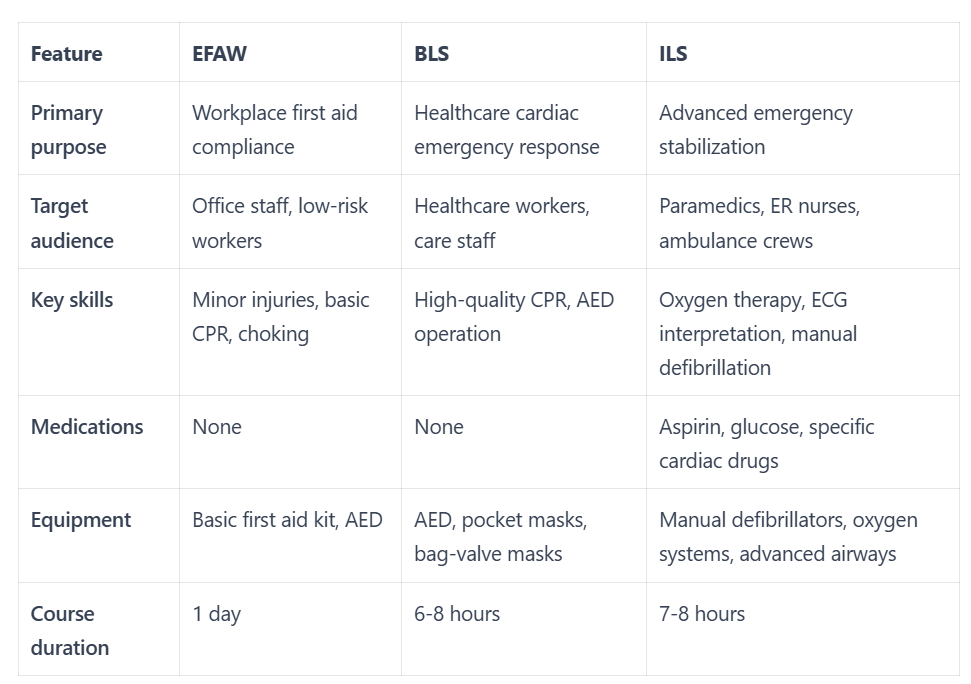
Understanding which certification you need starts with recognizing how these three qualifications differ in purpose, scope, and typical applications.
Scope of Practice Comparison
EFAW prepares you to handle workplace first aid—the cut finger, the employee who faints, the minor kitchen burn. BLS focuses specifically on cardiac and respiratory emergencies where immediate intervention determines survival. ILS adds the clinical tools and decision-making needed to manage complex cardiac scenarios before specialist teams arrive.
The progression is clear: EFAW is broad but shallow, covering many scenarios with basic interventions. BLS narrows the focus to life-threatening cardiac and respiratory emergencies. ILS deepens the cardiac emergency focus with advanced assessment and treatment capabilities.
Emergency Response Capabilities
An EFAW-trained first aider provides immediate care for common injuries and recognizes when to call emergency services. A BLS provider sustains life during cardiac arrest through effective CPR and defibrillation. An ILS provider diagnoses the type of cardiac emergency, chooses appropriate treatments, and manages the patient's condition while awaiting advanced care.
You wouldn't send an EFAW-trained office worker to manage a cardiac arrest in a hospital ward, and you wouldn't necessarily need an ILS-qualified paramedic to apply a plaster to a paper cut. Each certification serves its specific purpose.
Legal Authority and Limitations
Each certification operates within defined boundaries established by regulatory bodies and professional standards. EFAW providers work under HSE workplace first aid guidelines, which emphasize supportive care and early activation of emergency services. BLS providers follow Resuscitation Council UK guidelines for basic life support, which clearly define non-invasive interventions only.
ILS providers operate under more complex clinical protocols that allow medication administration and advanced interventions but still exclude invasive procedures like intubation or surgical airways. Working outside your scope of practice creates legal and ethical issues regardless of your intentions.
Which Life Support Certification Does Your Workplace Need?
Determining the right training for your organization starts with honest assessment of the risks your staff face and the regulatory requirements that apply to your sector.
Healthcare and Clinical Settings
BLS represents the minimum competency for all healthcare staff because cardiac emergencies can occur anywhere in a clinical environment. Most healthcare employers require BLS certification for all patient-facing staff as a condition of employment.
ILS becomes necessary for staff in emergency departments, acute care wards, ambulance services, and dental practices where you may be the first responder to a cardiac emergency. These roles require the additional assessment and treatment capabilities that ILS provides, particularly ECG interpretation and oxygen therapy.
Corporate Office Requirements
Standard office environments typically satisfy HSE requirements with EFAW-trained first aiders distributed throughout the building. The calculation depends on your workforce size, shift patterns, and whether you have any higher-risk activities.
Many organizations train more staff than the minimum requirement to account for holidays and absences. At least one EFAW-qualified first aider per floor or work area provides reasonable coverage.
High-Risk Industry Standards
Construction sites, manufacturing facilities, and warehouses face different requirements based on their risk profiles. While EFAW may suffice for office-based staff, you'll likely need full First Aid at Work (FAW) qualification for workers with machinery, hazardous materials, or high-risk operational areas.
Some organizations adopt a tiered approach—EFAW for general staff, FAW for supervisors and high-risk areas, and BLS for occupational health teams. This balances appropriate coverage with training costs.
Training Requirements and Certification Process
All three certifications emphasize practical, hands-on training because emergency response skills deteriorate rapidly without regular practice. You can't learn effective CPR from reading—you practice on manikins until the compression depth, rate, and rhythm become automatic.
Course Duration Comparison
EFAW courses typically run for six hours (one day), covering the breadth of workplace first aid scenarios without deep clinical detail. BLS courses also take approximately six to eight hours, but the time concentrates on perfecting high-quality CPR technique and AED operation through repeated practice.
ILS courses extend to a full day (seven to eight hours) because they add ECG interpretation, oxygen therapy, and clinical decision-making to the BLS foundation. The additional time allows for scenario-based practice that simulates real emergencies where you assess, decide, and act under pressure.
Assessment Methods
Competency in all three qualifications is demonstrated through practical assessment—you'll perform CPR on manikins, demonstrate correct AED pad placement, and show you can manage airways effectively. Some courses include written components to test knowledge of protocols and recognition of emergency situations, but the emphasis remains on demonstrated practical ability.
The assessment proves you can perform these skills correctly when someone's life depends on it. Instructors look for correct technique, appropriate decision-making, and the ability to work effectively under simulated emergency stress.
Renewal and Recertification
EFAW, BLS, and ILS certifications all expire and require regular renewal to maintain validity. EFAW typically requires renewal every three years, while BLS and ILS certifications expire annually.
Research consistently shows that CPR quality deteriorates within months without practice. Healthcare employers often require more frequent refresher training than the minimum certification period to maintain staff competency and confidence.
Making Compliance Simple with Professional On-Site Training
Kasorb delivers EFAW, BLS, and ILS training directly to your workplace with experienced instructors who bring real frontline experience from emergency departments and ambulance services. Our paramedics and ER nurses share insights from actual emergencies that help your team understand why techniques matter and how to apply them under pressure.
We focus on practical training that reflects the real risks in your workplace. Rather than generic scenarios, our instructors work with you to identify the specific emergencies your team might face and build training exercises around those situations.
Book your compliance training today and give your team the confidence and competence they need to respond effectively when emergencies occur.
Frequently Asked Questions About Life Support Training
Can EFAW holders perform CPR?
Yes, EFAW training includes basic CPR and AED operation for cardiac emergencies in workplace settings. However, the CPR training in EFAW focuses on workplace scenarios rather than the healthcare-focused approach taught in BLS courses.
How often must certifications be renewed?
EFAW certification expires after three years, while BLS and ILS certifications require annual renewal to maintain validity. Many healthcare employers require more frequent refresher training to keep skills sharp between formal recertification dates.
Is online certification valid in the UK?
Practical skills assessment occurs in person for all three qualifications because you can't demonstrate CPR quality or equipment operation through a computer screen. Some courses offer blended learning with online theory components followed by face-to-face practical assessment.
What medications can ILS providers administer?
ILS-trained providers can give specific emergency medications including aspirin for suspected heart attacks, glucose for low blood sugar, and certain cardiac drugs like adrenaline during resuscitation attempts. The medication list is defined by established protocols and varies slightly between training providers based on local guidelines.
Do you need BLS before taking ILS?
BLS typically serves as a prerequisite for ILS training because intermediate skills build directly upon basic life support foundations. You'll struggle with ECG interpretation and advanced airway management if you haven't mastered high-quality CPR and basic airway techniques first.


Book a free 15-min consult call with us. We’ll help you get your mandatory training done right.