Moving and Positioning People Training for UK Healthcare

Moving and Positioning People Training for UK Healthcare
Moving and positioning people training teaches healthcare workers how to safely assist individuals with limited mobility while preventing injury to both carers and patients. This specialized education covers the biomechanics of human movement, proper equipment use, and risk assessment techniques that comply with UK regulations including the Manual Handling Operations Regulations 1992 and CQC standards.
Most healthcare organizations require this certification for anyone who physically assists with patient transfers, repositioning, or mobility support. This guide explains what the training involves, who needs it, the legal requirements behind it, and how to choose the right format for your team.
What Is Moving and Positioning People Training
Moving and positioning people training teaches healthcare workers how to safely assist individuals with limited mobility while preventing injury to both the carer and the person being moved. This specialized education covers the biomechanics of human movement, proper equipment use, and risk assessment techniques that comply with UK regulations including the Manual Handling Operations Regulations 1992 and CQC standards. The training typically includes both theoretical principles and hands-on practice with equipment like hoists, slide sheets, and transfer boards.
Unlike manual handling of objects, moving people requires understanding dignity, consent, and person-centred care alongside physical techniques. Most courses run for three hours and include classroom learning plus scenario-based exercises that mirror real workplace situations. You'll work with experienced instructors—often paramedics, ER nurses, or NHS-trained professionals—who bring frontline healthcare experience to the training environment.
UK Legislation and CQC Requirements
Healthcare employers have a legal duty to provide moving and positioning training to staff who assist people with mobility needs. This obligation stems from multiple pieces of legislation that work together to protect both workers and patients.
Manual Handling Operations Regulations
The Manual Handling Operations Regulations 1992 (MHOR) require employers to avoid hazardous manual handling operations where reasonably practicable. Where avoidance isn't possible, employers assess the risks and reduce them to the lowest level reasonably achievable. These regulations specifically apply to moving people in care settings, meaning organizations document risk assessments for common transfers and positioning tasks.
Staff training forms a central part of meeting legal requirements, as untrained workers cannot safely implement risk reduction measures.
Health and Social Care Act Obligations
The Health and Social Care Act 2008 establishes a statutory duty of care for healthcare providers. Organizations are legally responsible for ensuring staff have the competency to perform their roles safely, including patient handling tasks. Regulatory bodies can take enforcement action against providers who fail to maintain adequate training standards, including improvement notices, fines, or in serious cases, prosecution for breaches that lead to harm.
CQC Fundamental Standards
The Care Quality Commission expects all healthcare staff to receive appropriate training for their roles, with clear records of competency assessments. During inspections, CQC assessors review training matrices, certificates, and practical competency records for moving and positioning. The fundamental standard of safety specifically requires that staff have the qualifications, competence, skills, and experience necessary to keep people safe.
Missing or expired moving and positioning certificates often feature in CQC inspection reports as evidence of inadequate safety systems.
Who Needs Moving and Handling Certification and How Often
The specific roles requiring certification depend on whether staff physically assist people with mobility or positioning tasks. Most healthcare organizations take a broad approach to ensure comprehensive workforce competency.
Healthcare Support Workers
Care assistants, support workers, and healthcare assistants in hospitals, care homes, and domiciliary care settings receive full moving and positioning certification. These team members typically perform the majority of patient transfers and repositioning tasks throughout their shifts. The training enables them to conduct risk assessments, select appropriate equipment, and execute safe transfers independently or as part of a team.
Nurses and Allied Health Professionals
Registered nurses, physiotherapists, and occupational therapists require certification even though they may delegate many routine transfers to support staff. These professionals often assess patient mobility, plan handling strategies, and supervise complex transfers that require clinical judgment. Senior clinical staff also carry responsibility for identifying when handling plans require updating based on changes in patient condition.
Agency and Bank Staff
Temporary workers, locums, and agency staff obtain valid certification before working in healthcare facilities. Organizations remain legally responsible for ensuring these workers have appropriate training, even though they're not permanent employees. Many healthcare providers verify certificates during the booking process and maintain copies in temporary staff files.
Refresher Intervals
Most healthcare organizations require moving and positioning refresher training annually, though some extend this to 18 months for experienced staff with good competency records. The frequency depends on several factors including the complexity of patient handling in the setting, incident history, and organizational risk appetite. Staff who don't regularly perform patient handling tasks—such as those who've been on extended leave—typically receive a practical refresher before resuming these duties.
Core Principles That Prevent Injury and Protect Dignity
Four fundamental principles underpin all safe patient handling techniques, regardless of the specific transfer or equipment involved. Understanding these concepts helps you adapt your approach to different situations rather than simply memorizing rigid procedures.
1. Natural Spine Alignment
Keeping your spine in its natural S-curve during transfers protects the vertebrae and surrounding muscles from strain. This means avoiding twisting, excessive bending forward, or reaching far from your body while supporting weight. You'll position yourself close to the person you're assisting and move your feet rather than twisting your torso.
2. Base of Support and Centre of Gravity
Your base of support—the area between your feet—determines your stability during transfers. A wider stance with one foot slightly forward creates a stable platform and allows you to shift weight smoothly between feet rather than lifting with your back. Understanding centre of gravity helps you recognize when someone is balanced and stable versus at risk of falling.
3. Communication and Consent
Every transfer begins with explaining what you're about to do and gaining the person's consent and cooperation. This conversation includes checking for pain, asking about their preferred method, and agreeing on count signals if you're working as a team. Throughout the transfer, you'll maintain communication to ensure the person feels safe and dignified.
4. Team Coordination
When two or more carers assist with a transfer, clear communication prevents injury and ensures smooth, coordinated movement. One person typically leads by giving clear instructions and counting to synchronize the team's actions. The leader assesses the situation, confirms everyone's ready, and calls the timing while other team members follow these cues precisely.
Essential Equipment Techniques Every Carer Must Master
Modern patient handling relies on equipment that reduces manual lifting and protects both carers and patients. Your training will cover the most common devices and when to use each one.
Common equipment includes:
- Slide sheets: Two layers of low-friction fabric that glide over each other to reduce effort when moving someone in bed
- Transfer boards: Bridge the gap between two surfaces like a bed and wheelchair for lateral transfers
- Hoists and slings: Eliminate manual lifting for patients who cannot bear weight
- Positioning aids: Pillows, wedges, and cushions that maintain safe positions and prevent pressure injuries
Slide Sheets and Transfer Boards
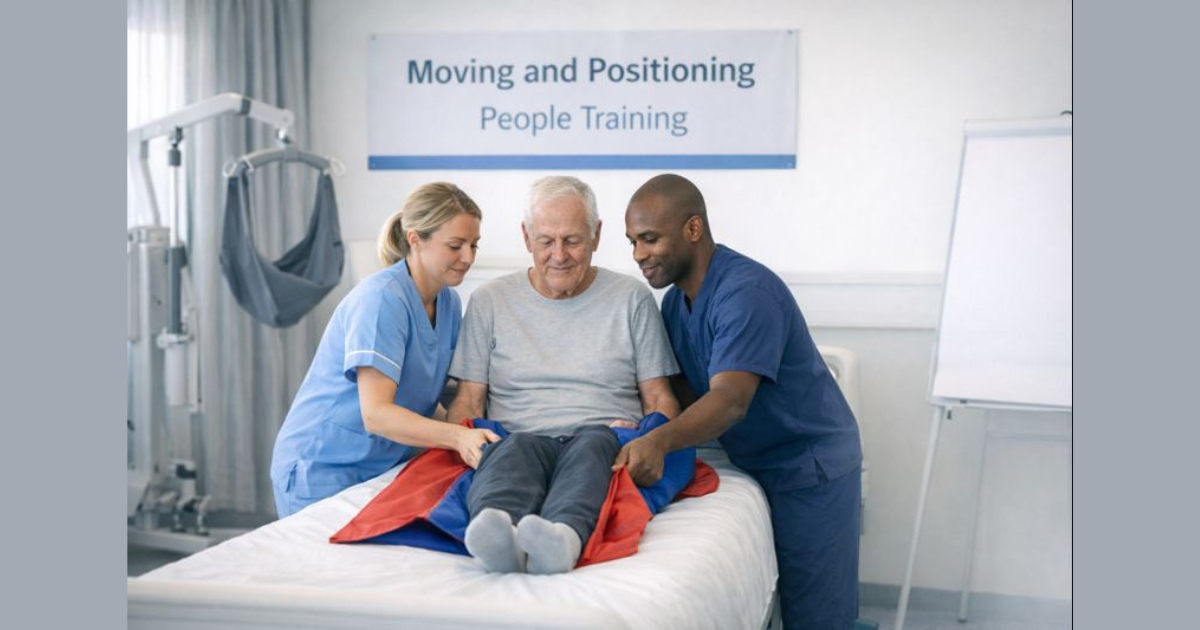
Slide sheets dramatically reduce the effort needed to move someone in bed. You'll learn to position them under the patient, perform the transfer, then remove them completely—leaving slide sheets in place creates pressure injury risks. Transfer boards provide a smooth sliding surface for lateral transfers, allowing the person to slide across rather than being lifted.
Hoists and Slings
Hoists eliminate manual lifting for patients who cannot bear weight or assist with transfers. You'll learn to select the correct sling type and size, position it properly under the patient, attach it securely to the hoist, and operate the controls smoothly. Different sling designs serve different purposes—toileting slings have an opening for bathroom use, while full-body slings provide maximum support for patients with no trunk control.
Safety checks before every use include inspecting the sling for damage, verifying weight capacity, and ensuring all attachment points are secure.
Turning and Repositioning in Bed
Log rolling maintains spinal alignment when turning someone in bed, which is particularly important for patients with spinal injuries or precautions. The technique involves multiple carers working in unison to turn the person as a single unit while supporting the head, shoulders, hips, and legs. Repositioning for pressure relief typically happens every two to four hours for immobile patients.
Chair and Wheelchair Transfers
Pivot transfers work for patients who can bear some weight and follow instructions. The technique involves helping the person stand, pivot on their feet, then lower into the new seat—you'll learn proper hand positioning and how to use the person's momentum rather than lifting their weight. Before any wheelchair transfer, you'll check that brakes are locked, footrests are moved aside, and the chair is positioned at the optimal angle.
Step-By-Step People Handling Risk Assessment
Every transfer requires a quick risk assessment, even for routine movements you've performed hundreds of times. Conditions change—patients become weaker, environments get cluttered, and your own physical state varies day to day.
1. Task Analysis
Start by clarifying exactly what happens and identifying potential hazards in this specific transfer. A transfer from bed to chair in the morning when the patient is rested differs significantly from the same transfer in the evening when they're fatigued. Consider the distance to be covered, any obstacles in the path, and whether the transfer involves any particularly risky elements like steps or narrow doorways.
2. Individual Capability
Assess both the patient's abilities and your own limitations honestly. Can the person bear weight, follow instructions, and cooperate with the transfer? Do they have pain, dizziness, or other symptoms that might affect their participation? Equally important is recognizing your own capacity—if you're feeling unwell, fatigued, or dealing with an injury, you might require additional help even for transfers you'd normally manage independently.
3. Load and Equipment Checks
Determine the person's weight and mobility level to select appropriate equipment. Someone who weighs 90kg but can stand and pivot requires different equipment than someone of the same weight who cannot bear any weight. Once you've selected equipment, verify it's functioning properly and suitable for the task.
4. Environment Inspection
Survey the space for adequate room to maneuver equipment and position yourself properly. You'll want clear floor space, good lighting to see what you're doing, and a clear path between the starting point and destination. Environmental hazards like wet floors, trailing cables, or clutter significantly increase fall and injury risks.
5. Documentation and Review
Record your assessment findings in the person's care plan, noting any changes from previous assessments. This documentation helps colleagues understand the current approach and provides evidence of your risk management process. Reassessment happens whenever someone's condition changes significantly—after illness, surgery, or changes in mobility.
What To Expect From a Kasorb On-Site Session
Kasorb's moving and positioning training brings experienced healthcare professionals directly to your workplace for practical, scenario-based learning. This approach means your team trains on the actual equipment they'll use and in the spaces where they'll perform transfers.
Course Duration and Group Size
A typical session runs for three hours with up to twelve participants, balancing comprehensive coverage with enough hands-on practice time for everyone. The schedule flexes around your operational needs—training can happen during day shifts, evenings, nights, or weekends.
Hands-On Scenario Practice
You'll spend the majority of training time practicing transfers and positioning techniques with real equipment, not just watching demonstrations. The instructor sets up scenarios that mirror your actual workplace situations—the types of patients you care for, the equipment you use, and the spaces you work in. Paramedics, ER nurses, and NHS-trained instructors bring frontline experience to these practice sessions.
Competency Assessment and Certification
Assessment happens throughout the training as the instructor observes your technique during practical exercises. You'll demonstrate key skills like risk assessment, equipment selection, and safe execution of common transfers. Successful participants receive certification valid for twelve months, along with documentation for your training records and CQC compliance files.
Delivery Options and Group Pricing Across the UK
Different training formats suit different organizational requirements, from comprehensive on-site sessions to flexible blended approaches that combine online theory with practical verification.
On-Site Workplace Training
Training in your facility means participants practice with your actual hoists, slide sheets, and other equipment rather than generic training devices. They also learn to navigate your specific room layouts, bed types, and environmental factors that affect transfers. Kasorb delivers on-site training throughout the UK, with instructors traveling to your location and bringing any additional equipment needed for comprehensive practice.
Virtual Live Classroom
Interactive online sessions with real-time instructor guidance work well for theory components and refresher training for experienced staff. The instructor demonstrates techniques, answers questions, and facilitates discussions about risk assessment and problem-solving. However, purely virtual training doesn't provide the hands-on practice required for initial certification in most healthcare settings.
Blended Learning With Practical Sign-Off
Combining online theory modules with shorter in-person practical sessions offers flexibility while meeting competency requirements. Staff complete knowledge components at their own pace, then attend a focused practical session to demonstrate their skills and receive certification. This approach works particularly well for refresher training where staff already know the principles but require updated certification and demonstrated current competency.
Ready To Keep Your Team Safe and Compliant With Kasorb
Moving and positioning training protects your staff from injury while ensuring patients receive safe, dignified care that meets regulatory standards. Kasorb's approach combines experienced healthcare instructors, practical hands-on learning, and flexible delivery options that fit your operational requirements.
Our paramedics and NHS-trained professionals bring real-world expertise to every training session, ensuring your team learns techniques they'll actually use in practice. With flat group rates for up to twelve people and nationwide coverage, compliance becomes straightforward and cost-effective.
Book your team's training session today and give your staff the skills and confidence they require to handle patient mobility safely.
FAQs About Moving and Positioning People Training
Do CQC inspectors accept online-only moving and handling certificates?
CQC expects practical competency demonstration for moving and positioning training, so purely online certificates without hands-on assessment typically don't meet regulatory standards. Most healthcare settings require blended learning with practical sign-off or full on-site training that includes observed practice and competency assessment.
Can night-shift teams receive on-site training during their working hours?
Kasorb provides flexible scheduling including evening and night-shift training sessions to accommodate 24-hour healthcare operations. Training can happen during quieter periods or shift changeovers, allowing night teams to receive the same quality training as day staff without disrupting patient care or requiring staff to attend on their days off.
Will the trainer bring hoists and slide sheets if our facility does not have them?
Kasorb instructors bring essential training equipment including slide sheets and transfer boards to ensure comprehensive hands-on practice. However, training on your facility's specific hoist models is recommended for optimal learning outcomes, as different manufacturers have varying controls and safety features that staff require understanding for daily use.


Book a free 15-min consult call with us. We’ll help you get your mandatory training done right.